My Cart


 All Products
 Fasteners

 Pneumatic Fittings

 Brass Fittings
 Hand tools
 Bearings and Grease

 Electrical Terminal


 Zinc Plating
 Nut and Screw
 Product Packaging


How to Read Fastener Sizes from Product Labels in 5 Minute.
How to Read Fastener Sizes from Product Labels in 5 Minute.
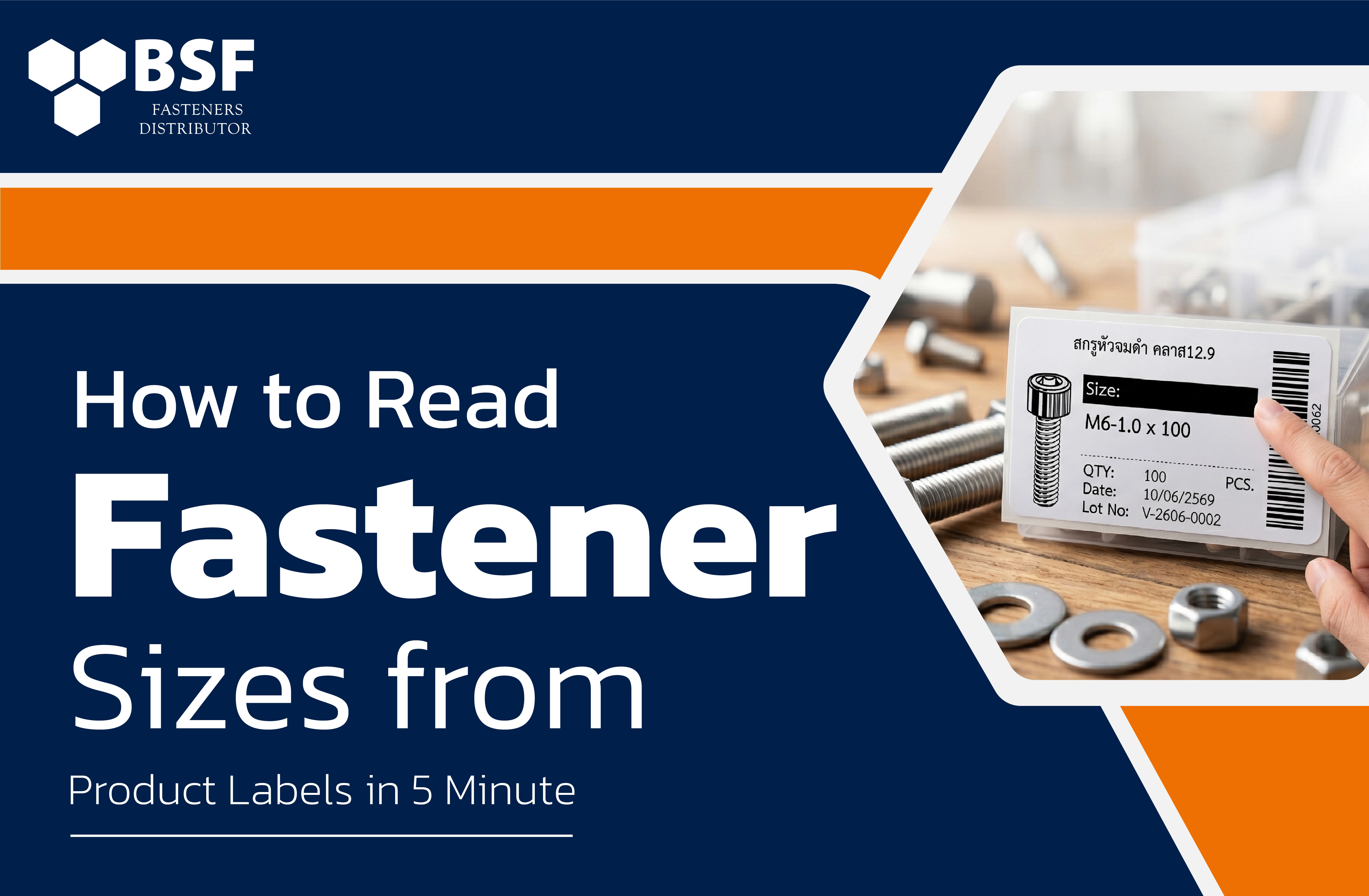
An easy-to-understand guide on how to read screw, nut, and bolt sizes from product labels, along with explanations of thread sizes, lengths, and various standards. This is perfect for novice technicians, contractors, or anyone starting to buy screws, nuts, and bolts. Reading product labels can seem complicated because the packaging displays numbers, sizes, standards, and strength grades. If you don't understand them, you might choose the wrong product for the job. In this article, we will take you through a simple way to read fastener label information that can be put into practical use within 5 minutes.
 ยาวไปอยากเลือกอ่าน
Why is it important to know how to read fastener sizes?
Why is it important to know
how to read fastener sizes?
Screws, nuts, and bolts may look similar to many people, but in reality, each fastener has distinct sizes, standards, and properties. Knowing how to read fastener sizes is an essential skill that helps you choose and use them correctly, safely, and more efficiently.

Helps you choose the right product.
Knowing how to read sizes helps you choose the right fastener for the job, reducing the risk of buying the wrong size or getting something unusable.
Reduces purchasing mistakes.
Understanding labels ensures correct ordering, reducing mistakes and return time.
Improves strength and safety.
Properly sized fasteners ensure the workpiece is securely attached, provide good load resistance, and guarantee safety during use.
Makes communication with sellers and technicians easier.
Clearly specifying sizes and specs ensures accurate and fast ordering.
Saves time and reduces costs.
Choosing the right fastener from the start reduces rework and unnecessary costs.
What do the numbers on a fastener mean?
What do the numbers on a fastener mean?
The numbers on a fastener specify thread size, length, and standards. When looking at product labels or bolt heads, you might see various numbers and letters like M8 × 30, 1/4”x1”, Grade 8.8, or DIN 933, and wonder what they mean. Understanding this information will help you select the right fastener for your specific application.
Black Socket Head Cap Screw, Class 12.9, M6-1.0 × 100
This specification can be interpreted as follows :
Black socket head cap screws are hexagonal socket head cap screws
with a black surface coating.
M6 = 6 mm thread diameter.
1.0 = 1.0 mm thread pitch.
100 = 100 mm length.
Class 12.9 = strength grade of the fastener.

What Are Metric and Inch Systems?
What are metric and inch systems?
Fasteners are generally categorized into two main sizing systems: the Metric system and the Inch system, which are standard frameworks used in industries worldwide. Understanding the differences between these two systems will help you choose the correct screws, nuts, or bolts and prevent problems caused by using the wrong size.
Metric System
It is a system widely used in Thailand and many countries around the world, using millimeters (mm) as the unit of measurement. Sizes are typically designated with the letter M, such as M6, M8, or M10, where the number following M indicates the thread diameter.
For example, M8x25.
The meanings are as follows :
- M = metric thread
- 8 = 8 mm thread diameter
- 25 = 25 mm length.
Inch System
It uses inches as the unit of measurement, such as 1/4", 3/8", or 1/2", and is commonly found in machinery or equipment imported from the United States. Its thread standards differ from the Metric system.
For example, 1/4"x1"
The meanings are as follows :
- 1/4" = thread diameter of 1/4 inch
- 1" = length of 1 inch
Where Is Screw Length Measured From?
Where is screw length measured from?
Screw length is measured from "under the head to the tip of the thread" for standard screw heads, such as hex or Phillips heads. However, for countersunk or recessed screws, the measurement includes the total head height because the head is designed to sit flush with the workpiece. Measuring the length correctly helps you choose a screw that fits the workpiece perfectly and avoids installation or loose-fastening issues.
Note : Countersunk screws are always measured "including the head" because they are the only type where the head sinks completely into the material surface.
What Are Grade 4.8, 8.8, 10.9, and 12.9?
What Are Grade 4.8, 8.8, 10.9, and 12.9?
Grade, or strength class, is a numerical value used to indicate the load-bearing capacity of bolts and screws. The higher the number, the stronger the fastener and the more load it can handle. Choosing the right grade for your specific application is crucial for the overall safety and lifespan of the assembly.
Grade 4.8

This is a standard grade for general, low-load applications that is cost-effective and highly versatile.
- General applications
- Equipment installation
- Light structural work
- DIY projects
Grade 8.8

This is the most popular grade for industrial and machinery applications, offering good tensile and impact resistance.
- Machinery applications
- Steel structures
- General industrial applications
Grade 10.9

This is a high-tensile grade (High Tensile Bolt) specifically designed for heavy-load applications.
- Heavy machinery
- Industrial equipment
- High-load applications
- Certain automotive components
Grade 12.9

This ultra-high tensile grade can handle high tension and torque, making it ideal for applications that require exceptional strength.
- Industrial machinery
- High-load equipment
- Engineering work requiring exceptional strength
Common mistakes when reading product labels.
Common mistakes when reading product labels.
One of the most common issues when choosing fasteners is misreading the label information, such as confusing the thread size with the length, choosing the wrong thread system (Metric vs. Inch), or overlooking the bolt's strength grade. Additionally, many people forget to check if the material and surface coating match their operating environment, leading to wrong orders, installation failures, or poor performance. Therefore, you should always verify the essential details on the label—including thread size, length, strength grade, material, and manufacturing standards—to ensure you select the correct, safe, and most suitable fastener for your project.
FAQ
FAQ
It is an 8 mm metric thread screw with a length of 25 mm.
No. Metric and inch threads have different sizes and thread profiles.
These numbers represent the strength grades of fasteners—the higher the number, the more load they can support.

Summary

สรุป
Reading fastener sizes from product labels is not difficult once you understand the key information, such as thread size, length, measurement units, strength grade, and manufacturing standards. These details help ensure that the selected screw, nut, or bolt is suitable for the intended application. Understanding product labels also helps reduce purchasing mistakes, prevents selecting the wrong size or grade, and improves the strength and safety of the assembly. By spending just a few minutes learning how to read fastener labels, you can choose the right fastener with confidence and achieve more reliable, efficient results.
แชร์ :




Contact
Boonsan Fasteners Limited Partnership.
1874, 1874/1-3 Moo 4, Soi Narai 2,
Theparak Road, Mueang District,
Samut Prakan Province, 10270
Tel. : 02-026-6558
Open : 08.00-17.00 Mon-Sat
 Boonsanfast
  @boonsanfast
  www.boonsanfasteners.com
  ecom_order@boonsanfasteners.com
 Payment Method