My Cart


 All Products
 Fasteners

 Pneumatic Fittings
 Brass Fittings
 Hand tools
 Bearings and Grease
 Electrical Terminal

 Zinc Plating
 Nut and Screw
 Product Packaging


How to choose fasteners for industrial applications
How to choose fasteners for industrial applications
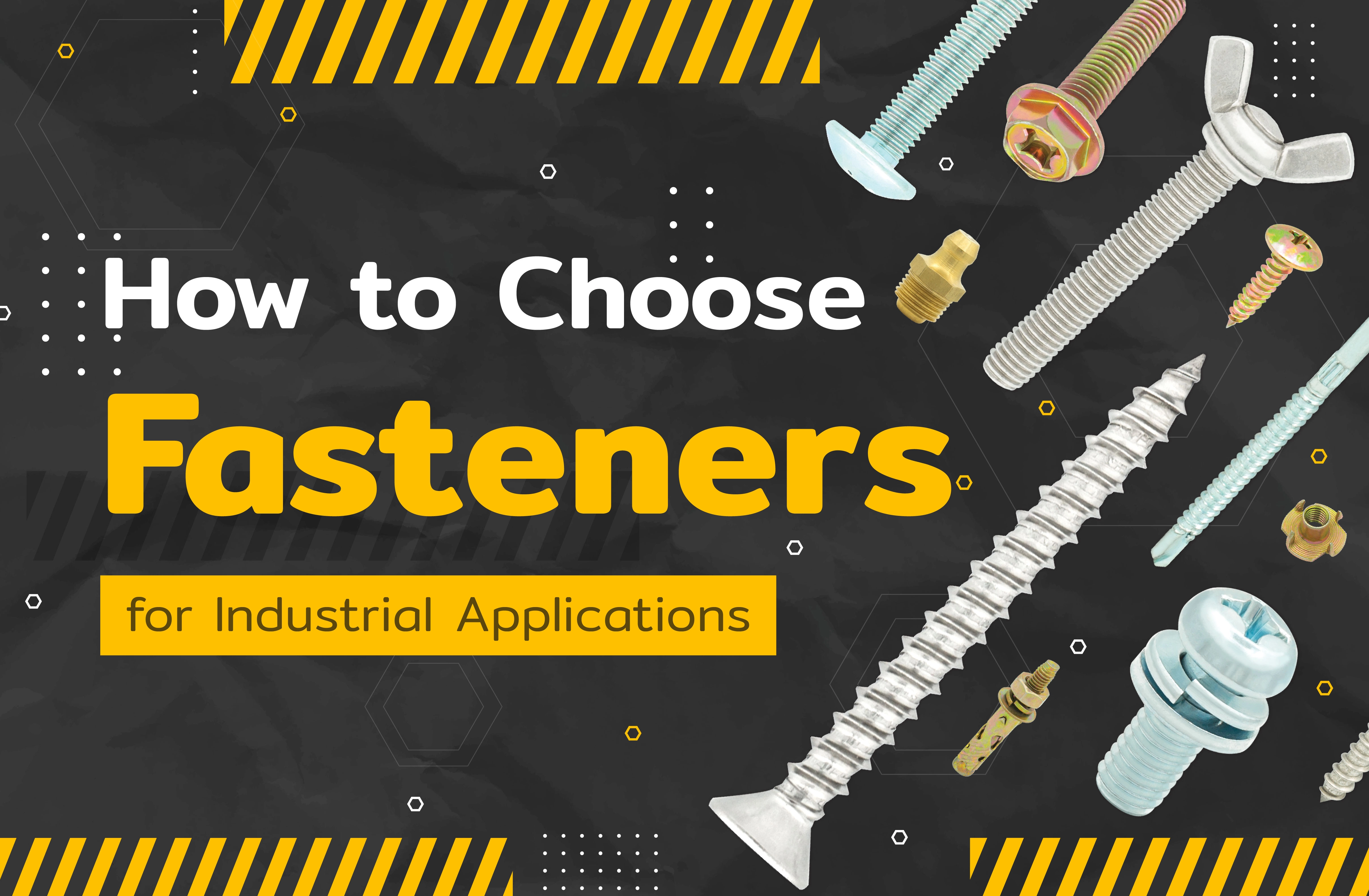
A guide to choosing the right fasteners for industrial applications, including screws, nuts, and bolts, to match machinery, load requirements, and industrial standards for improved safety and long-term cost efficiency.
In industrial factories, fasteners such as screws, nuts, and bolts are essential components that directly affect safety, production quality, and the service life of machinery.
Although they may seem like small parts, selecting the wrong fastener for the application can lead to problems such as loosening, corrosion, machine damage, or even production line downtime.
 ยาวไปอยากเลือกอ่าน
Why are fasteners important in industrial factories?
How to Choose Fasteners for Industrial Factory Applications
How to choose fasteners for industrial applications
Choose fasteners that match the application type.
Choosing the right fastener for the application is essential for improving strength, safety, and service life because each type of application has different operating conditions, environments, and load requirements.
For example:
- For steel structure applications, high-strength bolts or screws with corrosion protection coatings such as HDG (Hot-Dip Galvanized) should be used.
- For machinery applications, fasteners with good vibration resistance should be selected and used together with anti-loosening components.
- For electrical or electronic applications, fasteners should be corrosion resistant and should not interfere with electrical systems.
- For furniture or decorative applications, fasteners with an attractive surface finish such as zinc plating or nickel plating are recommended.
- For coastal areas or high-humidity environments, stainless steel or HDG fasteners should be used for long-term corrosion protection.
Choose materials that are suitable for the operating environment.
The material of a fastener directly affects its durability and service life because each environment involves different factors such as humidity, water exposure, chemicals, or temperature. If the wrong material is selected, it may lead to rust, corrosion, or component failure.
For example:
- For general indoor applications, zinc-plated or yellow zinc-plated steel fasteners are commonly used.
- For outdoor applications or high humidity environments, SUS304 stainless steel or HDG fasteners are recommended.
- For coastal areas or chemical plants, SUS316 stainless steel is recommended because it provides superior corrosion resistance.
Check Fastener Standards.
Standardized fasteners provide peace of mind regarding size, strength, and manufacturing quality—ensuring safe use and minimizing the risk of failure. Before choosing a fastener, always verify its standards, strength grade, and specifications to fit your application so it can efficiently handle workloads and operating environments.
Common standards include:
Choose the right strength grade for the application.
Different fastener grades have varying load-bearing capacities. If an inappropriate grade is selected, screws or bolts may loosen, deform, or fail during operation.
For example:
- Grade 4.8 is suitable for general-purpose applications.
- Grade 8.8 is suitable for machinery and structural applications.
- Grade 10.9 or 12.9 is suitable for high-strength, heavy-load applications.
Verifying the correct thread system
Choosing the correct thread system to match the workpiece is essential for ensuring secure fastening and safe operation. Using the incorrect thread type can lead to assembly failure, stripped threads, or loosening during operation.
Common thread systems include:
- Metric Threads
- Imperial Threads (UNC / UNF)
Why do factories choose high-quality fasteners?
FAQ
Summary
แชร์ :




Contact
Boonsan Fasteners Limited Partnership.
1874, 1874/1-3 Moo 4, Soi Narai 2,
Theparak Road, Mueang District,
Samut Prakan Province, 10270
Tel. : 02-026-6558
Open : 08.00-17.00 Mon-Sat
 Boonsanfast
  @boonsanfast
  www.boonsanfasteners.com
  ecom_order@boonsanfasteners.com
 Payment Method